When making a purchase, we all want to pay as little as possible. Nobody likes realizing two weeks later that the product or service they bought is now on sale and that they should have waited. This reality also holds true in the travel industry. Everyone tries to find their dream trip while paying the best possible price. Is it better to wait for last-minute sales or to book in advance to get the best deal? As a professional in this field, I want to share some important information and my opinion on the subject.
If we go back 20 years, before travel found its place in the online marketplace, wholesalers set travel prices based on approximations and hoped to fill hotels and planes at that price. As the departure date approached, unsold seats became direct losses for them. To mitigate these losses, they would contact travel agencies and offer "last-minute" prices to clear their inventory. Profits per person were thus reduced, but the direct losses were eliminated. The feedback loop allowing the wholesaler to adjust their price was slow, and price changes took time to produce results.
But that model is now a thing of the past. The new reality means that price fluctuations have become smaller. Why? I'll explain the pricing mechanics that are currently in place. With online commerce, the feedback loop has become much faster. Inventory is accessible in real time, and changes are perceived instantly. Take, for example, a trip listed at $1,280. As soon as it's listed at $1,250, it becomes more attractive. The consumer then wonders: will the price drop further, or will it go back up in the next few days? Typically, they wait and hope. Then, as soon as the price rises slightly, the customer goes to checkout to avoid missing out on the "discounted price."
This mechanism allows wholesalers to generate a quick response and fill previously empty seats. But the question remains: Are there still "last-minute" deals? In my opinion, it's a bit like the "Boxing Day" phenomenon. Those who rush to the shops at noon on December 26th know this. Of course, there are clearance items. But the discounts target unpopular products that no one wanted to buy a few days earlier. Is it really a good deal? In the travel industry, it's much the same. If there are rooms left over one or two days before departure, chances are they aren't the best. I'm not saying there aren't good deals, but the risk of being disappointed is greater. By buying these "leftovers," we tell ourselves that at least we didn't pay too much...
What is the solution to finding the best product at the best price?
1. Get expert advice on choosing two or three hotels within your price range that meet your criteria. This advice can come from a travel agent or a friend who has visited the place. You can also consult online reviews, but keep in mind that everyone has their own personal criteria, and without a verbal exchange, it becomes difficult to fully understand the individual's evaluation criteria. Personally, since travel agent advice is usually free, it would be foolish not to take advantage of it.
2. Take the time to assess the trends for your chosen hotels. Your search should begin no later than 8 to 12 weeks before departure. Those who are meticulous and disciplined can even create charts to track price changes daily and try to predict fluctuations. Beware! A group booking a large number of rooms is all it takes to thwart a well-organized price monitoring plan.
3. Be ready to act quickly. If you are acting on behalf of a group and need their approval before making a purchase, you could miss out on a great opportunity. Make sure you have everything you need to book when the opportunity arises: names, dates of birth, contact information, and payment methods (credit card numbers).
Just a reminder that Discount Travel offers unique tools to help you take advantage of price drops. Hotel price alerts and the option to receive daily search results by email are simple and automatic ways to increase your chances of finding the best price.
The price depends on the time
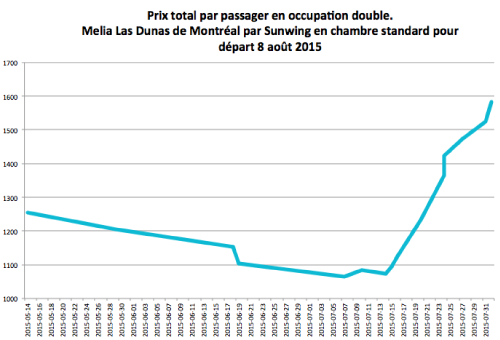
The graph below clearly illustrates how the price of a package varies as you get closer to the departure date. For the hotel we tracked, the best price was offered 3.5 weeks before departure. For another hotel or another departure date, it might vary by a few days, but the general trend will remain the same. People who book well in advance usually want to be sure they have a choice and place more importance on this criterion than on price. As time goes on, the price drops to attract those who want the best deal. Once the break-even point is reached, the price rises again. The remaining spots will essentially be sold to the highest bidder. You're probably wondering who's playing the price game. It's the wholesalers who set the prices and work to fill their flights and hotels. That's perfectly normal! They're trying to make a profit on the products they offer you. Travel agents do not have inventory to manage and have no incentive to raise prices. This curve differs during peak periods because demand is often very high and people book further in advance. For Spring Break and the holiday season, the lowest point of the curve will occur a few weeks earlier.
Have a great vacation!